

As Pokémon cards continue to attract significant value on the secondary market, Lord Foster—Chair of Peers for Gambling Reform and a member of the House of Lords—has described the Pokémon TCG as “a particularly good case to pursue” in the debate over gambling legislation, questioning the Gambling Commission's interpretation of “money or money's worth” under the Gambling Act 2005.
The secondary market has grown considerably in recent years. Even recent Pokémon sets that are still being printed have produced cards worth four-figure sums. Add a coveted '10' grade from a grading company, and a Pokémon TCG card sitting in your binder could be worth even more. While the Gambling Commission's position is that subsequent trading or resale does not, in itself, make the original purchase gambling, correspondence seen by Kanto Post shows that Lord Foster is challenging the regulator's reasoning.
In a letter dated 21 July 2026, Lord Foster wrote to the Gambling Commission in his capacity as Chair of Peers for Gambling Reform, arguing that: "Given the existence of this established resale market, it is not immediately apparent why Pokémon cards would not constitute 'money's worth' for the purposes of the Gambling Act."
 Callum Self
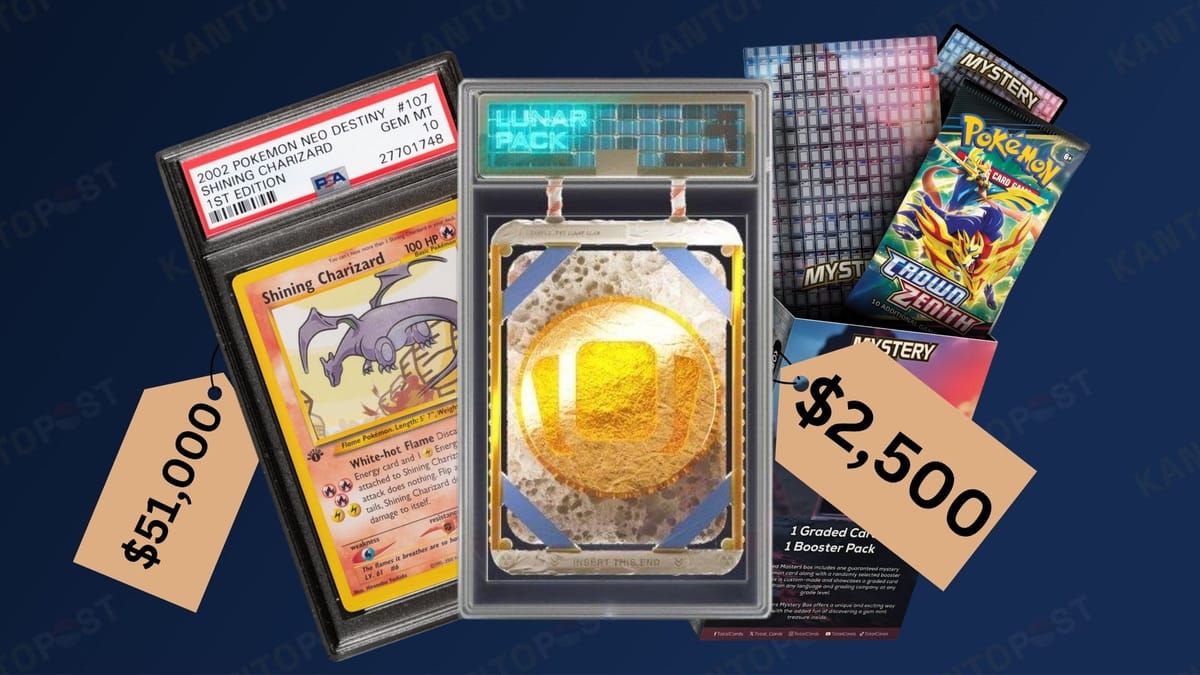
For context, Section 6 of the Gambling Act 2005 defines gaming, in the gambling sense, as “playing a game of chance for a prize”. The Act defines a prize to include “money or money's worth”.
Lord Foster refers to the Commission's previous position that Pokémon cards fall outside the Act, because purchasers receive cards rather than money or money's worth. He asks the Commission for further explanation, writing: "where those cards clearly possess an objectively ascertainable financial value and can readily be exchanged for cash, I would welcome further explanation of the legal basis for concluding that they do not satisfy the statutory definition."
In his letter, Lord Foster also points to the ways collectors can sell their cards through "a wide range of established and entirely lawful channels". These include local card shops, marketplace platforms and select retailers. Comparing this with the third-party sale of in-game skins obtained through loot boxes, he adds that "the resale and monetisation of Pokémon cards takes place through mainstream, legitimate and entirely lawful commercial channels."
Lord Foster also questions the Commission's position in the context of the audience for trading card games. He notes that TCGs such as Pokémon are "heavily marketed towards children and young people", while recognising that many people collect cards purely for enjoyment. He argues that the Commission's regulatory position should reflect how these cards are bought, sold and valued.
In a response dated 11 August 2026, Sarah Gardner, Acting Chief Executive of the Gambling Commission, addressed Lord Foster's concerns, stating: "In our view, the fact that Pokémon cards may subsequently be traded or sold on a secondary market does not, of itself, mean that their sale constitutes gambling."
Gardner's response continues by arguing that Parliament did not intend the Gambling Act 2005 to cover the sale of trading cards or football stickers simply because their purchase includes a chance-based element.
 Callum Self

The response also explains that the Commission may investigate products or services that could fall within the definition of gambling. Gardner says this "may include those products or services where overtly gambling-like features are incorporated into what would otherwise be considered a shopping platform or experience."
Gardner concludes her correspondence by explaining that the Commission does not consider it appropriate to divert resources towards products or services it believes fall outside its remit. She explicitly confirms that it is "not currently undertaking activity in relation to the purchase or trading of collectable cards or stickers".
She adds that the Commission's responsibilities include protecting children and other vulnerable people from being harmed or exploited by gambling, but says it must carry out those responsibilities within the definitions established by the Gambling Act 2005. Gardner concludes that any changes to those definitions, and consequently to the Commission's remit, powers and resources, are matters for “government and Parliament to decide.”
Lord Foster has long campaigned for gambling reform, including greater scrutiny of gambling-like features in video games. In a follow-up email to Kanto Post, he explained that Pokémon cards are part of a wider range of ‘gambling-like’ products that “can lead to real gambling”.
He also referred to the 2020 House of Lords report on gambling, in whose work he said he was heavily involved. Lord Foster said the report had "specifically recommended a change in the definition of what constitutes gambling". Regarding Pokémon cards, he described them as "a particularly good case to pursue because there is clear evidence that cash trading does take place."
The Gambling Commission's response leaves open questions about how its position might apply to other products and services involving chance-based purchases. However, its letter does not establish that all trading cards or products involving randomised card purchases fall outside the Gambling Act. We reached out to the Gambling Commission, where a spokesperson stated that they're still making enquiries with colleagues. They did not respond with a statement in time for publication.
The letters were provided to Kanto Post by Lord Foster. The article reproduces selected extracts from the correspondence. Reach out to callum@kantopost.com for any questions.


