

The Cyberpunk TCG has plenty of room for different strategies, from aggressive crews that rush to steal Gigs to control decks that keep your opponent’s Units in check. I’ve picked out a competitive deck, the best starter deck to buy, and my personal favourite.
You don’t need to chase the most expensive Welcome to Night City cards to build a decent deck, either. Buying singles is a good way to fill gaps in your collection, while a Cyberpunk TCG booster box gives you more options to experiment with.
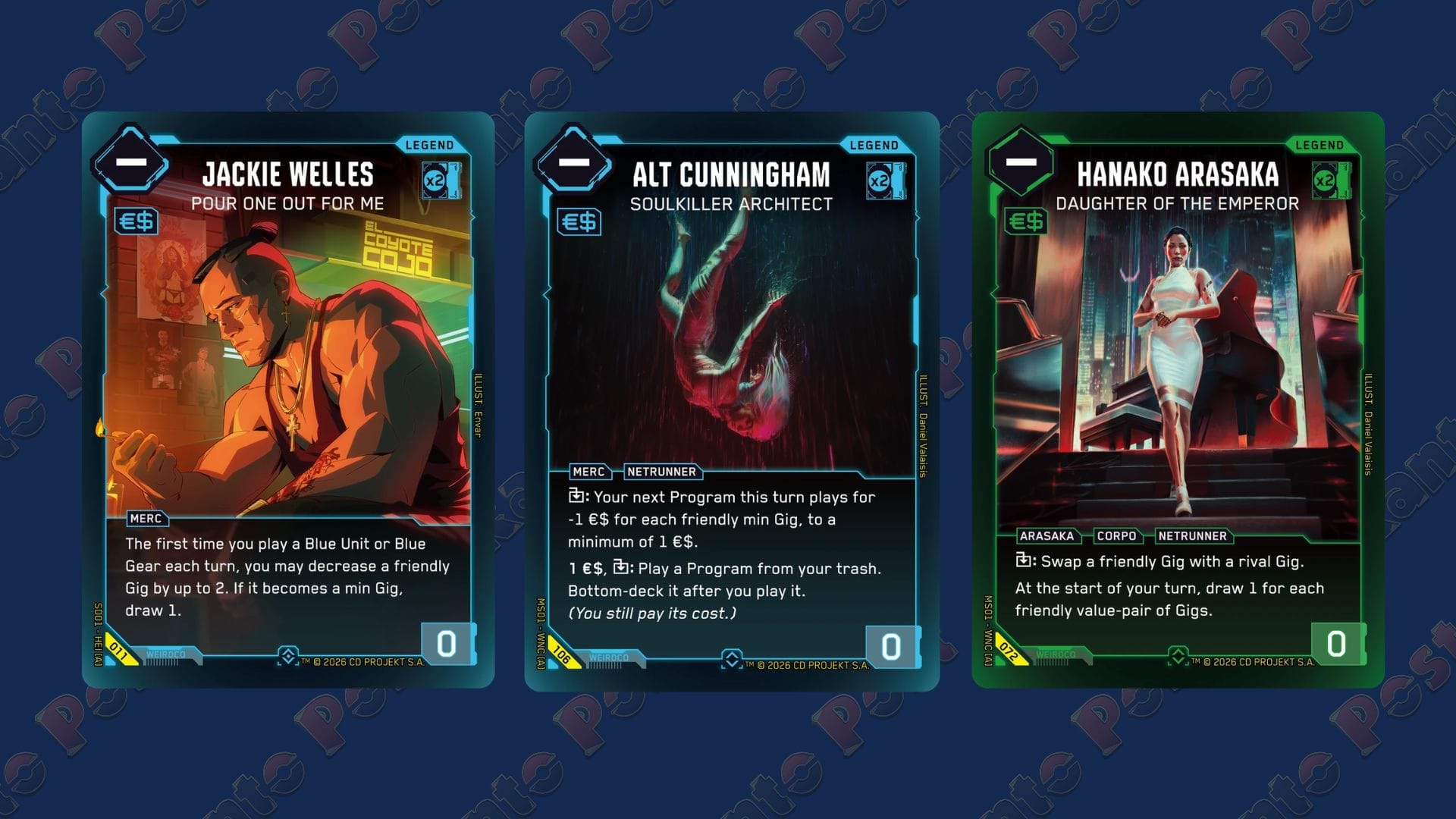
Best Cyberpunk TCG deck overall
Deck: BBG Control-Combo
Difficulty: Advanced
Legends:
- Alt Cunningham: Soulkiller Architect
- Hanako Arasaka: Daughter of the Emperor
- Jackie Welles: Pour One Out For Me
Main deck:
- 3x Jacked-In Voodoo Boy
- 3x Les Élémens
- 3x Nocturne OP55 N1
- 3x Peace Offering
- 3x Pepe Najarro: Working Doubles
- 3x Pyramid Song
- 3x Three Mouths, One Desire
- 3x Towerfall
- 3x Trust No One
- 3x Valentino Street Racer
- 2x Chrome Reverie
- 2x Floor It
- 2x Lizzy Wizzy: Delicate Weapon
- 2x Maman Brigitte: Spirit of Death
- 2x Take Control
- 1x Delamain: Rideshare AI
Additional sideboard options:
- 2x Delamain: Rideshare AI
- 1x Modded Kusanagi
This is the most advanced deck on my list, but it’s also one of the most interesting to play. The BBG Control-Combo strategy uses Blue and Green cards to manipulate Gigs, draw extra cards, and disrupt your opponent’s board. It takes a little practice to get right, but it can put you in a strong position once its key interactions come together.
The three Legends are the heart of the strategy. Jackie Welles: Pour One Out For Me lets you decrease the value of a friendly Gig by up to two the first time you play a Blue Unit or Blue Gear each turn. If that Gig becomes a min Gig, you also draw a card. This gives you a way to turn your Gigs into a source of extra cards while setting up the rest of your deck.
Alt Cunningham: Soulkiller Architect works particularly well with this approach. Her first ability reduces the cost of your next Program that turn by one Eddie for each friendly min Gig, down to a minimum cost of one. Her other ability lets you pay one Eddie to play a Program from your trash, but you still have to pay that Program’s normal cost. This gives you another opportunity to use a useful effect without relying on drawing the card again.
Hanako Arasaka: Daughter of the Emperor adds another layer to the strategy. She lets you swap one of your friendly Gigs with a rival Gig, while her other ability draws you a card for each pair of friendly Gigs with matching values. That makes the min Gigs created through Jackie’s ability particularly useful, as you can build matching pairs to trigger Hanako’s card draw.
The rest of the deck gives you plenty of ways to control the field. Cards such as Les Élémens, Pyramid Song and Take Control help you disrupt your opponent’s plans, while your Legends give you more ways to recycle Programs and generate card advantage.
The main weakness is that this deck needs time to get going. Aggressive decks built around Legends such as Adam Smasher, Judy Álvarez or V: Streetkid can put pressure on your Gigs before you’ve established your engine. You can also find yourself with an expensive opening hand that doesn’t give you many useful early plays. Even after a mulligan, you might not draw the cards you need.
I’d recommend learning the basics of the Cyberpunk TCG before trying this one. There’s plenty to keep track of, and you’ll get much more out of it once you understand how to manage your Gigs and Eddies.

Best Cyberpunk TCG starter deck
Deck: The Heist
Difficulty: Beginner
If you’re new to the Cyberpunk TCG, I’d recommend picking up The Heist starter deck over Embracing Power. Both are designed to get you playing straight out of the box, but The Heist is a little more forgiving while you’re learning the rules.
The biggest difference is the pace of the decks. The Heist has a lower average card cost, giving you more opportunities to play cards without having to save up your Eddies. It also has more Blockers and Quick Programs, which give you additional ways to respond to your opponent’s attacks.
Embracing Power is more focused on aggression. It can be a good choice if you want to put pressure on your opponent and make the most of its powerful Units, but I think The Heist offers a better starting point for someone who hasn’t played before.
The Heist also gives you a useful foundation for building your own decks. Its Legends, particularly Jackie Welles: Pour One Out For Me, have plenty of potential in custom builds. You can experiment with different Blue and Green cards as your collection grows, rather than having to replace the entire deck straight away.
Both starter decks include the cards you need to play, alongside a playmat and dice. They’re a straightforward way to learn the game before spending money on booster boxes or individual cards.
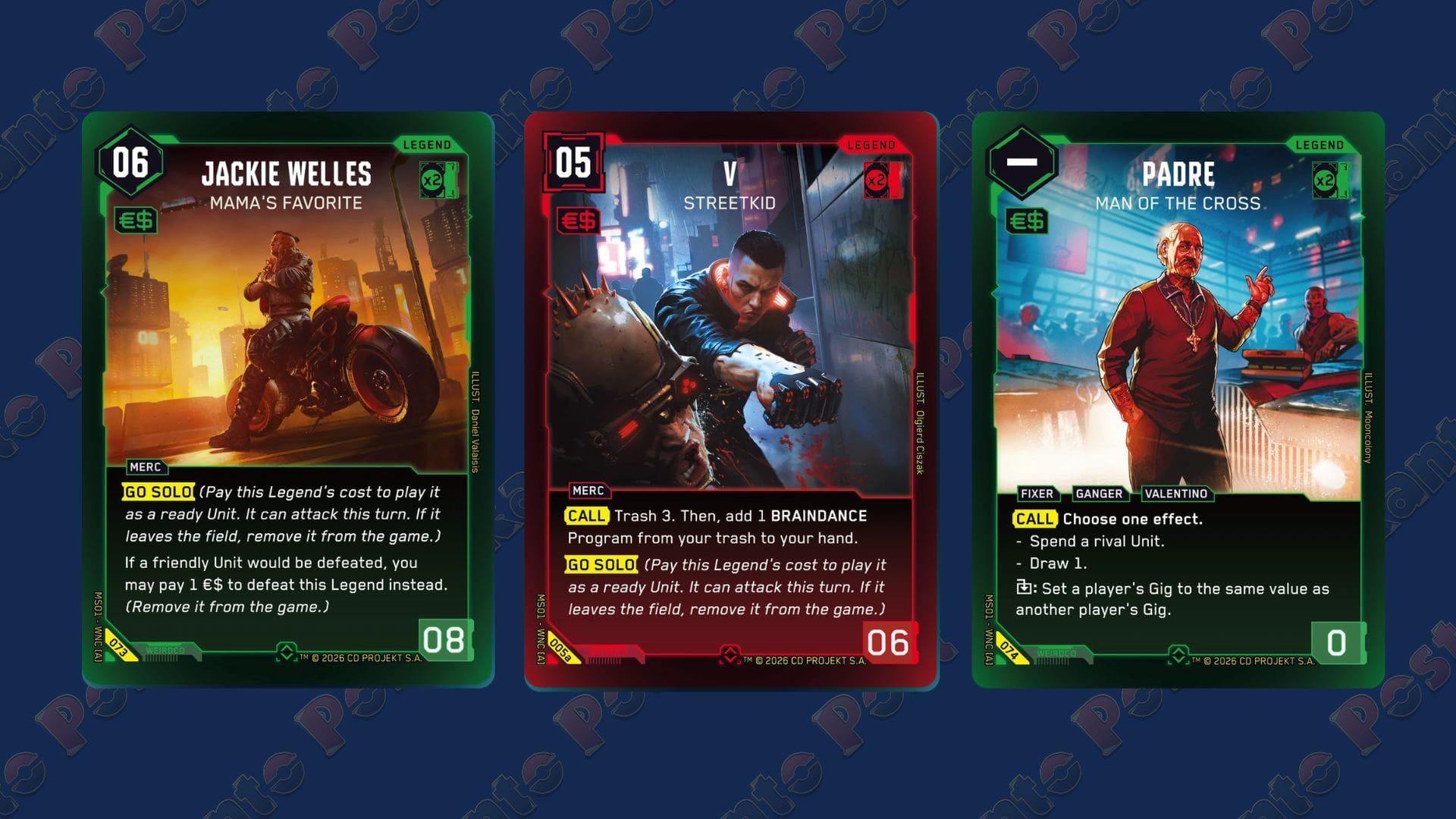
Kanto Post’s favourite Cyberpunk TCG deck
Deck: MaxTac Control
Difficulty: Beginner–Intermediate
This is the deck I had the most fun learning. I originally came across the MaxTac Control build while trying to beat The Rogue A.I. on the ChoomBattler simulator. It didn’t take long to get to grips with its strategy, and I eventually managed to beat the offline bots with it.
Legends:
- Jackie Welles: Mama’s Favorite
- Padre: Man of the Cross
- V: Streetkid
Units:
- 2x Corpo Security
- 3x Johnny Silverhand: Never Stop Fighting
- 2x La Llorona: Ghost of the Past
- 2x MaxTac AV
- 2x MaxTac Squadron
- 3x Meredith Stout: Stone Cold Corpo
Gear:
- 3x Mantis Blades
- 2x Overwatch: Panam’s Gift
- 2x Riot Shield
- 3x Sandevistan
- 3x Satori: Sword of Saburo
Programs:
- 3x (Don’t Fear) The Reaper
- 2x Fool on the Hill
- 3x Memory Relapse
- 2x Peace Offering
- 3x Wild in the Streets
Sideboard:
- 3x Nadia: Fighting Through Grief
- 1x Overwatch: Panam’s Gift
- 1x Riot Shield
- 2x Take Control
What I like about this deck is how it balances offence and defence. You have plenty of ways to protect your Gigs, but you’re also able to put pressure on your opponent when the opportunity comes along.
MaxTac Squadron is one of the cards that makes this strategy work. If it’s spent at the end of your turn, its ability readies a friendly face-up Legend. This gives you another way to make use of your Legends’ abilities and keep your options open.
Sandevistan works particularly well alongside MaxTac Squadron. You can equip it to the Squadron itself, allowing Sandevistan to ready it at the end of your turn. Just remember to resolve MaxTac Squadron’s own ability before Sandevistan’s effect. That way, you can ready a friendly Legend before MaxTac Squadron stands back up.
Johnny Silverhand: Never Stop Fighting is another brilliant addition. He defeats CORPO Units whenever he wins a fight against them, regardless of their power, provided Johnny has at least one power. He also readies himself the first time he wins a fight each turn. That makes V: Corporate Exile a particularly easy target, while giving Johnny another opportunity to attack.
(Don’t Fear) The Reaper is your late-game answer to a crowded enemy board. It spends every rival Unit before defeating one of those spent Units. That gives you a chance to remove an important threat and create an opening to steal Gigs.
One thing to remember is that MaxTac Squadron and Johnny Silverhand are Units, so they enter play with Lag. They can’t attack on the turn you play them unless another effect specifically allows it. You’ll need to plan around that when deciding when to spend your Eddies.
It’s a fairly straightforward deck to learn, and it was the first build I used to get comfortable with the game. However, it can struggle if you put all your resources into a single Unit. That’s where Blockers and defensive Gear come in handy, although your mileage will vary depending on the deck you’re facing.
How to build your own Cyberpunk TCG deck
One of the best things about the Cyberpunk TCG is that you don’t have to stick with the starter decks. You can build your own crew around your favourite characters, cards and strategies, provided you follow the game’s deckbuilding rules.
Choose your three Legends
Every Cyberpunk TCG deck needs exactly three Legends, and they must all have unique names. These are the characters that define your strategy, so it’s worth thinking about how their abilities work together before you start adding cards.
Try to pick Legends that support the same general approach. If you want to build an aggressive deck, look for abilities that help you attack, increase your Units’ power or steal Gigs. If you’d rather control the field, consider Legends that let you draw cards, disrupt your opponent or make better use of your Programs.
You can mix different colours, too, as long as you have enough RAM to include the cards you want.
Check your RAM limits
RAM is one of the most important parts of deckbuilding, and it’s easy to confuse it with a card’s Eddie cost. Your three Legends determine how much RAM you have available in each colour. Add together the RAM values of your Legends to calculate your limit for each colour.
Every card you include must have a RAM value that is equal to or lower than your limit for its colour. For example, if your Legends provide four Green RAM, you can include Green cards with a RAM value of up to four.
This is separate from the Eddie cost you pay to play a card during a match. A card can have a high Eddie cost and still fit your RAM limits, or have a low Eddie cost but be illegal in your deck because its RAM value is too high.
It’s worth checking this before you get too attached to a particular combination of cards.
Build your main deck
Your main deck must contain between 40 and 50 cards, not including your three Legends. You can include a maximum of three copies of a card with the same name and subtitle.
There are three main card types to consider:
- Units: Your crew members. They fight rival Units and attack Gigs to steal them.
- Gear: Equipment that gives your Units and Legends additional abilities or advantages.
- Programs: Instant effects that can disrupt your opponent, protect your crew or help you take control of the game.
Try to build a deck that has a mixture of card costs. If too many of your cards are expensive, you might struggle to make meaningful plays during the early turns. On the other hand, filling your deck with cheap cards doesn’t necessarily give you the power to deal with bigger threats later.
It’s also worth thinking about how your cards work together. A Unit that benefits from Gear is more useful if you have enough equipment to support it, while a deck built around Programs needs Legends and other cards that help you get the most out of those effects.
Make sure you have enough Eddies
You need Eddies to play cards, so don’t overlook how your deck generates them. Once per turn, you can sell a card with the Sell tag from your hand to gain one Eddie. You can also spend your Legends as Eddies, whether they’re face-up or face-down.
That means you need to think carefully about which cards you’re happy to sell. A card might look useful in a particular matchup, but it could be more valuable as an extra Eddie when you need to get an important Unit or Program onto the field.
Try to avoid building a deck that relies on drawing one specific card before it can do anything. Having a few different ways to make useful plays will make your deck more consistent.
Test your deck and make changes
Once you’ve put your cards together, the best thing you can do is play a few matches. You’ll quickly find out whether your deck has enough early plays, whether you’re running out of Eddies, and whether your Units can deal with the threats your opponent puts on the field.
Pay attention to the cards that regularly sit in your hand without being played. If you keep drawing expensive cards that you can’t afford, you might need to lower your average cost. If your opponent keeps stealing your Gigs, consider adding more Blockers or cards that can disrupt their attacks.
Don’t be afraid to change your Legends or swap out cards that aren’t working. Deckbuilding is a process, and you’ll often find better combinations as you get more familiar with the cards in your collection.
If you’re preparing for a tournament, check the event’s format rules before you play. Constructed events that use a sideboard require you to prepare seven additional cards, giving you more options to adapt your deck between games. Your sideboard cards must also follow the relevant deckbuilding and RAM restrictions.
FAQs
How many cards are in a Cyberpunk TCG deck
A Cyberpunk TCG deck contains exactly three Legends and a main deck of 40 to 50 cards. You can include up to three copies of a card with the same name and subtitle, and all cards must fit within the RAM limits set by your Legends.
What is the best Cyberpunk TCG starter deck?
I’d recommend The Heist for beginners. It has a lower average card cost than Embracing Power, alongside more Blockers and Quick Programs to help you respond to your opponent’s moves.
How do you win in the Cyberpunk TCG?
You win by starting your turn with at least seven Gigs in your Gig area. You can protect your own Gigs and attack your opponent’s to steal theirs. If neither player wins before Overtime, the first player to reach the required number of Gigs wins immediately.
Can you build your own Cyberpunk TCG deck?
Yes. You can build a custom deck using exactly three Legends and between 40 and 50 other cards. Your Legends determine your available RAM in each colour, which limits which cards you can include.


