

There are plenty of reasons to be frustrated with Pokémon right now. The price and availability of cards in the Pokémon TCG have gotten out of control, while the games are widely perceived to be worse than they used to be. The anime has moved on from Ash Ketchum, the young Pallet Town upstart who helped introduce an entire generation of fans to the franchise in the ’90s.
People still love Pokémon, though. 2026 marks its 30th anniversary, and in some ways, the franchise is bigger than it’s ever been. Everyone has their opinions, but, as with many things, we tend to hear most from the two extremes: people who love something and people who hate it.
One of the world’s biggest pop-culture franchises is arguably in its most polarising era, but it’s hard to know what people who aren’t deeply invested in it actually think. Someone who feels lukewarm about Pokémon probably isn’t going to spend their afternoon posting about it online. That doesn’t mean their perspective isn’t worth hearing.
As somebody who loves both Pokémon and data, I wanted to take the world’s temperature and find out what ordinary people actually think about Pokémon today.
This turned out to be harder than expected. I couldn’t just put out a survey about Pokémon because the people most likely to respond would probably be those with strong feelings about it. So I needed a group of random people who weren’t predisposed to caring about the amount of water in Ruby and Sapphire or that one tree in Sword and Shield.
There are enough TikTok street interviewers without me contributing to that mess (and I don’t have the charisma for it anyway), so I wanted to do my polling online. Where do you find regular people you can just talk to?
My first attempt was asking internet customer-service representatives from various companies. A real captive audience. The trouble is that most of them are now just AI agents, doomed to forever count how often the letter R appears in the word “strawberry”. Even when I did manage to connect with a real person, they weren’t interested in chatting unless I had an actual question about the business.
Props to these model employees for not wasting company time.
What ended up working were websites that randomly pair users and let them have text chats with each other, similar to once-popular platforms such as Omegle and Chatroulette (shoutout to the OGs who remember the peak, if one could call it that, of these sites). A quick Google search for “random chat” gave me a few different options that I ended up using, and with the infrastructure in place, I needed a plan.
I wanted a decent sample size without rededicating my life to this silly venture, so I decided to stop once I had responses from a tidy 100 people. These are fast-moving platforms, so I didn’t want to ask too much of random internet strangers.
I settled on two questions that could be answered quickly while still giving me a decent idea of where each person stood:
- “Do you watch Pokémon, play the games, or collect the cards?”
- “What are your impressions of Pokémon or your opinion of it today?”
As I began, I quickly noticed that the majority of users weren’t keen to participate. Most of my conversation partners moved on before I had the chance to ask my questions, or they bolted after inquiring about body parts I don’t have. I didn’t keep these stats, but I’d estimate I got a usable response from roughly one in every 10 people.
Finally, like Red receiving the Old Rod, I got my first bite. And, thanks to the “ASL” (age/sex/location, not American Sign Language) nature of these platforms, I was able to collect some self-reported demographic information.
For the sake of readability, I’ve edited responses from users that follow for grammar.
 Callum Self
My first participant was a 25-year-old American man (that’s what he said, anyway). His response was simple: “Watched Pokemon as a kid. Pikachu stayed in my memory. I think it is better than today’s cartoons”. It didn’t take long for the first negative opinion to arrive.
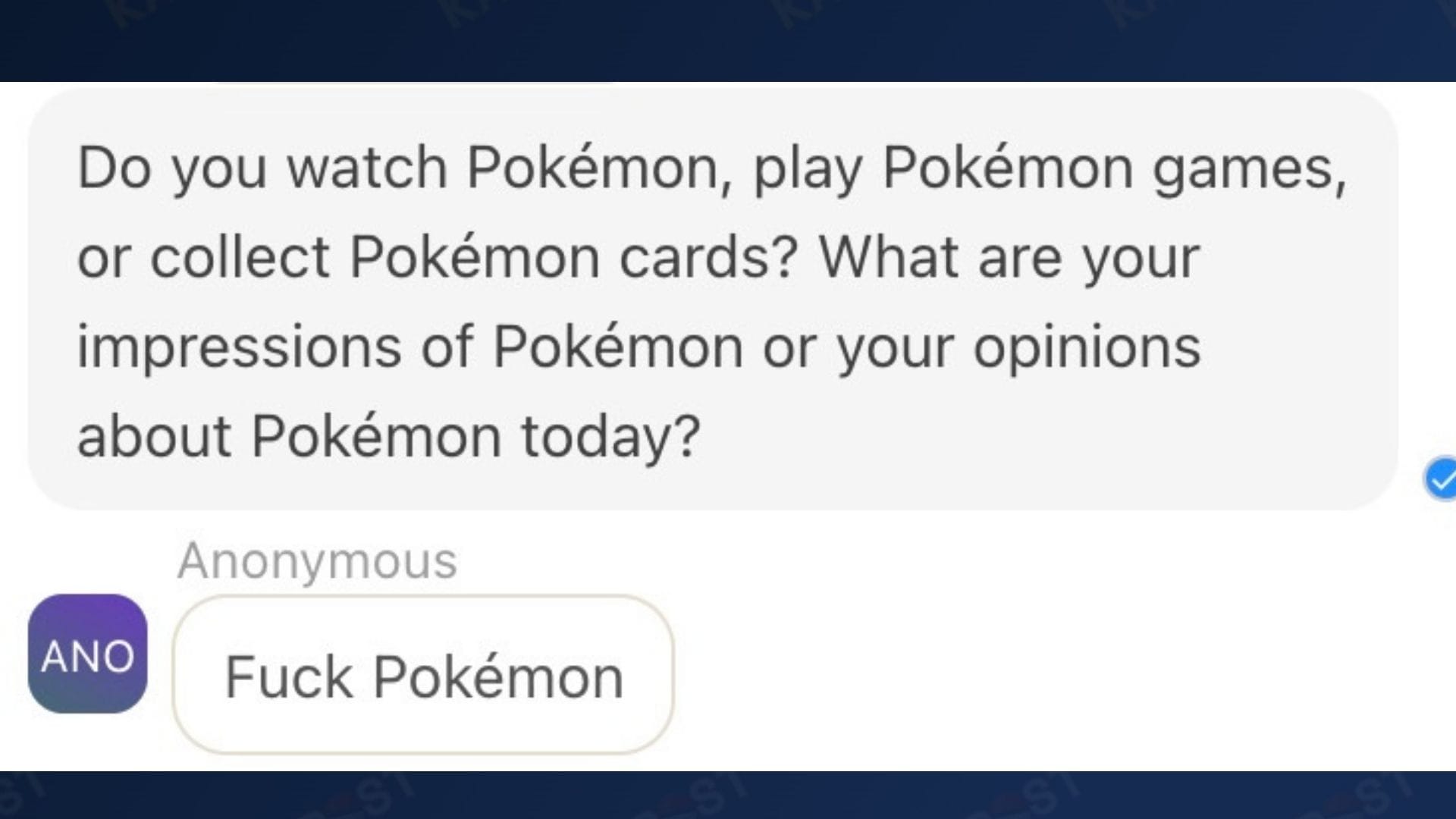
The very next person, a 21-year-old American guy, told me, “I used to do stuff like that, but now I think it’s a bit childish, you know?” A few people later, a 24-year-old American man stated simply and definitively, “F*ck Pokémon.”
The ninth overall respondent, a 45-year-old man from the UK, surprised me with an entirely different answer: “I don’t know what Pokémon is”. He was one of just two people who claimed total ignorance of the world’s biggest media franchise. These two were outliers, but not because of where they lived. I expected to mostly speak with Americans, but the final split was 52% participants from the US and 48% from elsewhere.
A 67-year-old man from Malta, the oldest person I spoke to, said, “Jeepers... My wife childminds 8-year-olds and they have Pokémon cards. I wouldn't know the first thing about Pokémon except one is called Charmander, apparently. The kids tell me some cards are valuable." After looking up “childminds” (it essentially means “babysits”), I told him that Pokémon cards can sell for thousands of dollars. “Amazing,” he replied.
One unfortunate 22-year-old American had already experienced a young Pokémon fan’s worst-case scenario. “I just started collecting. I lost all my cards in a fire as a kid and I just started again. I think it’s expensive for what it is, though." I mourned his loss and lamented how tough it must be to start over with the current state of the hobby. He responded, "Not a big deal. It sucks, but it is what it is."
A 45-year-old Canadian man was more aware of the current TCG situation. "Collectors [are] ruining the hobby," he said. "Kids can't buy cards." I mentioned how store shelves are frequently empty. “Kinda sh*tty,” he added.
Then there was a confusing exchange with a 34-year-old man from the Philippines. He started, "They were good during their time. But I don't think the kids know them now." Either the Pokémon scene in the Philippines is very different from what I’m used to seeing, or this person was unaware of the franchise’s current scale. Regardless, he continued, "I know them, though. I could make them real in real life, I think."
For a brief moment, I wondered if I’d stumbled across an experimental genetic scientist on the verge of a world-changing breakthrough. He continued: "Pokémon can transform, right? They are a perfect example of a good metamorphosis. Upgrade. What do you think?" I had no idea what to think. I asked outright if he was claiming he could create a real-life Pokémon. It turned out he was speaking more figuratively, about Pokémon as an example of personal growth. "Nope, not really. I mean the upgrades are real in life if someone gives his best to be better." That took a turn from bizarre to wholesome.
All of the responses I’ve mentioned so far came from men. Platforms like the ones I used don’t seem to be particularly comfortable spaces for women, which may explain their relative absence. Of the 100 people I spoke to, just four were women. One, a 24-year-old teacher from India, was my 100th and final chat.
She explained that she likes the anime but hasn’t had much time to watch it recently because of her busy schedule. She said it’s exciting to watch the show and see which new Pokémon will appear and what they can do. I asked if her students like it and she reported they're more into games like PUBG: Battlegrounds and Free Fire.
And with that, after a few hours of chatting spread across three days in early July, my polling was complete. It was time to see what the data actually said.
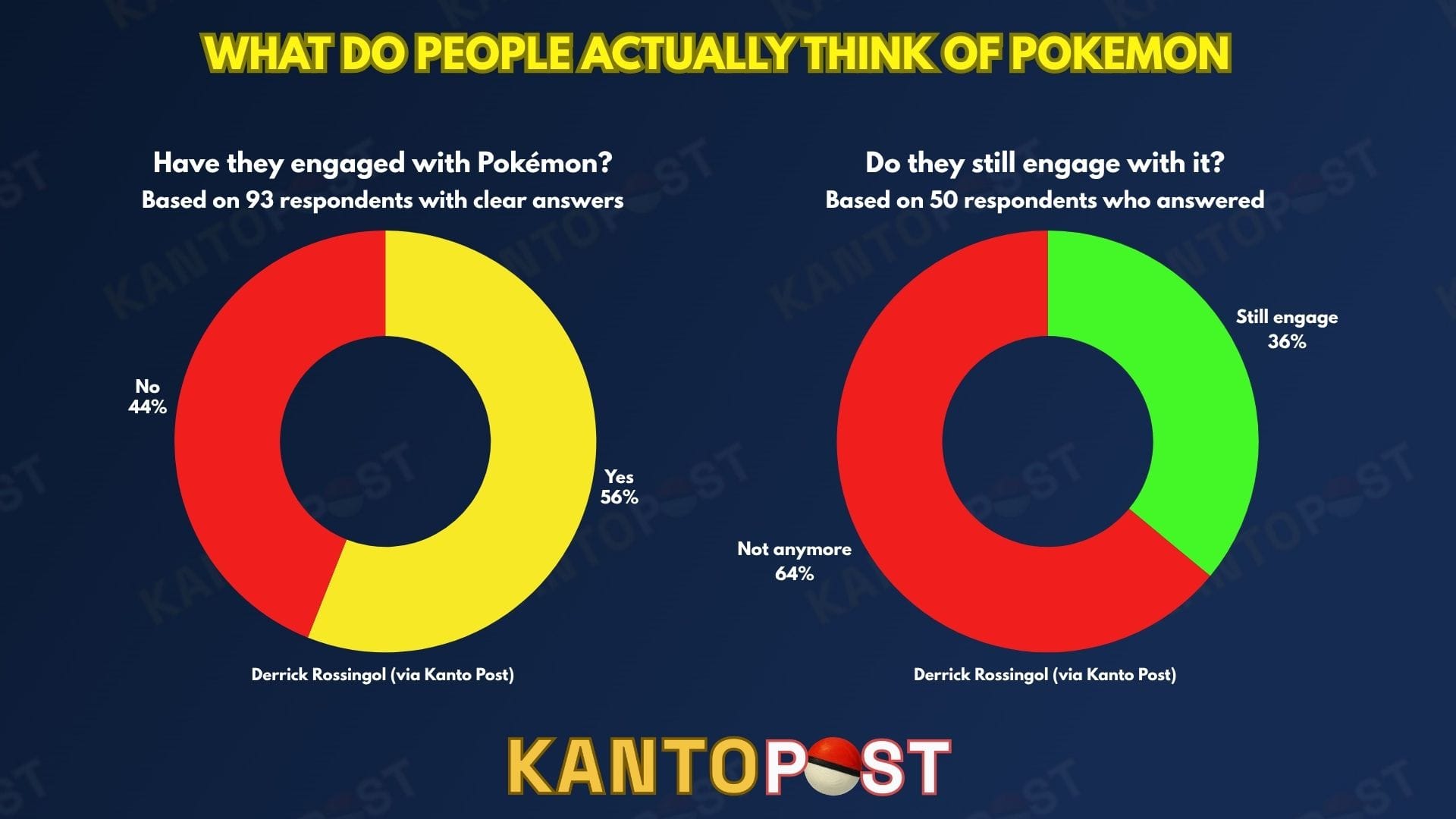
Of the 100 respondents, 93 clearly indicated whether they had ever engaged with Pokémon, whether through the games, cards or anime. Of those 93 people, 52, or about 56%, had. That means that if you picked a random person from this particular group, you’d have roughly a coin flip’s chance of finding someone who had ever got into Pokémon.
Out of the people who had previously engaged with Pokémon, 50 revealed whether they still engage with it today. Just 18 of them, or 36%, said they do. In other words, most of the respondents who tried Pokémon when they were younger hadn’t stuck with it or returned for the latest generation.
Overall, among the 93 people whose previous engagement with Pokémon could be determined, about 80% don’t currently play the games, collect the cards or watch the anime. Pokémon is a phenomenon, but even at its current scale, it’s possible to ignore.
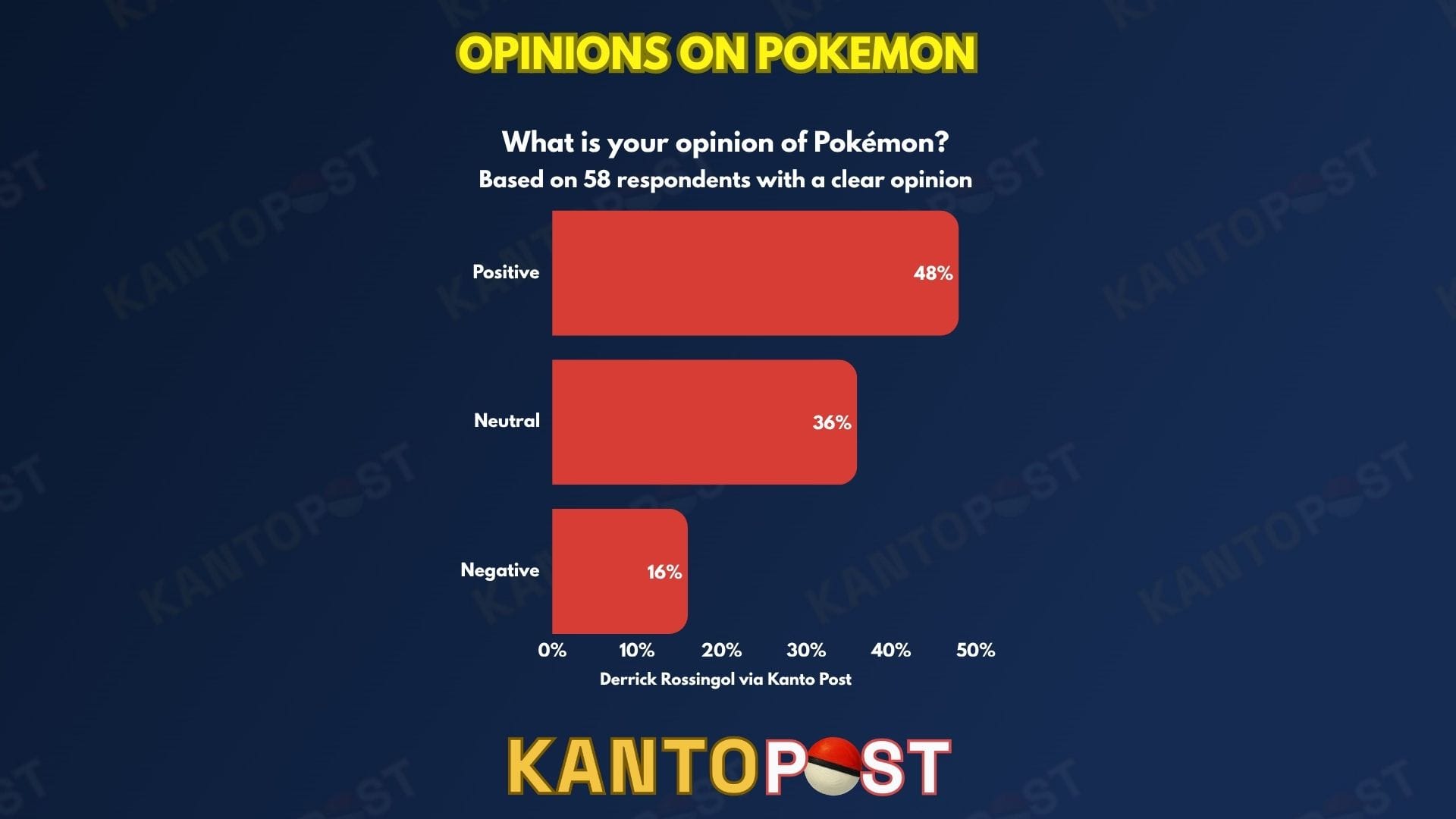
Finally, I analysed all of the responses to determine how many people had a positive opinion of Pokémon today. Of the 58 respondents whose opinion could be determined, 28 (48%) were positive, 21 (36%) were neutral and just nine (16%) were negative. The haters are overwhelmingly in the minority.
I also broke the results down by age, comparing respondents aged 30 and over with those under 30 (I didn’t speak to anybody younger than 18 because a 34-year-old man anonymously chatting with kids online felt like a bad look). The 30-plus group was small, with just 22 people, making it difficult to draw any meaningful conclusions. The trends were largely similar anyway. A comparison between Americans and non-Americans made more sense given the near-even split between those groups. However, there were no significant differences in their responses.
None of this is scientific data. The sample was non-random, the data collection was informal and the results lacked much of a female perspective. Any survey group will have some form of bias, and this one is no different. There’s also the possibility that people using relatively obscure random-chat websites are more likely to be interested in video games and other forms of entertainment than the general population.
Still, I found the results interesting. Most people don’t currently play, watch or collect Pokémon, but most of them don’t seem to have a major problem with it either. One response from a 32-year-old Brit might be the best encapsulation of what I found: "I don't watch Pokémon or play Pokémon now. As a kid, I did. The Game Boy games, and I enjoyed them a lot. I would happily play them again as an adult. Pokemon Red and Blue, I think they were. My opinion on it today: I don't really have one, other than I think it's crazy that people spend so much money on cards. But hey, who am I to judge anyone's hobby?"


