

The image above looks like a series of seemingly random squares. Multiple colours are scattered across a dark background in what appears to be utter chaos. It isn’t random - it’s every one of the 1,025 Pokémon currently in the Pokédex, reduced to tiny coloured squares that together create an interactive visualisation of the franchise.
As each new entry joins the franchise, a new slew of Pokémon get added to the official Pokédex - what started as the initial 151 is now over 1,000. Displaying all 1,025 Pokémon at once would normally be demanding on both your browser and your device, but Akash’s approach keeps everything smooth and responsive.
Each square is selectable, delivering a picture of the selected ‘mon, highlighting their type and respective stats. It also shows which generation it belongs to. However, things only get more interesting as you scroll along the page, as the data flies around to fit and showcase different patterns - ones you likely never expected to see.
“I wanted to see the whole dex as one picture instead of a list you scroll forever,” creator Akash told Kanto Post. He said it took two weeks to develop, but most of it was collecting the data as opposed to developing the code, using PokéAPI and checking it against Bulbapedia.
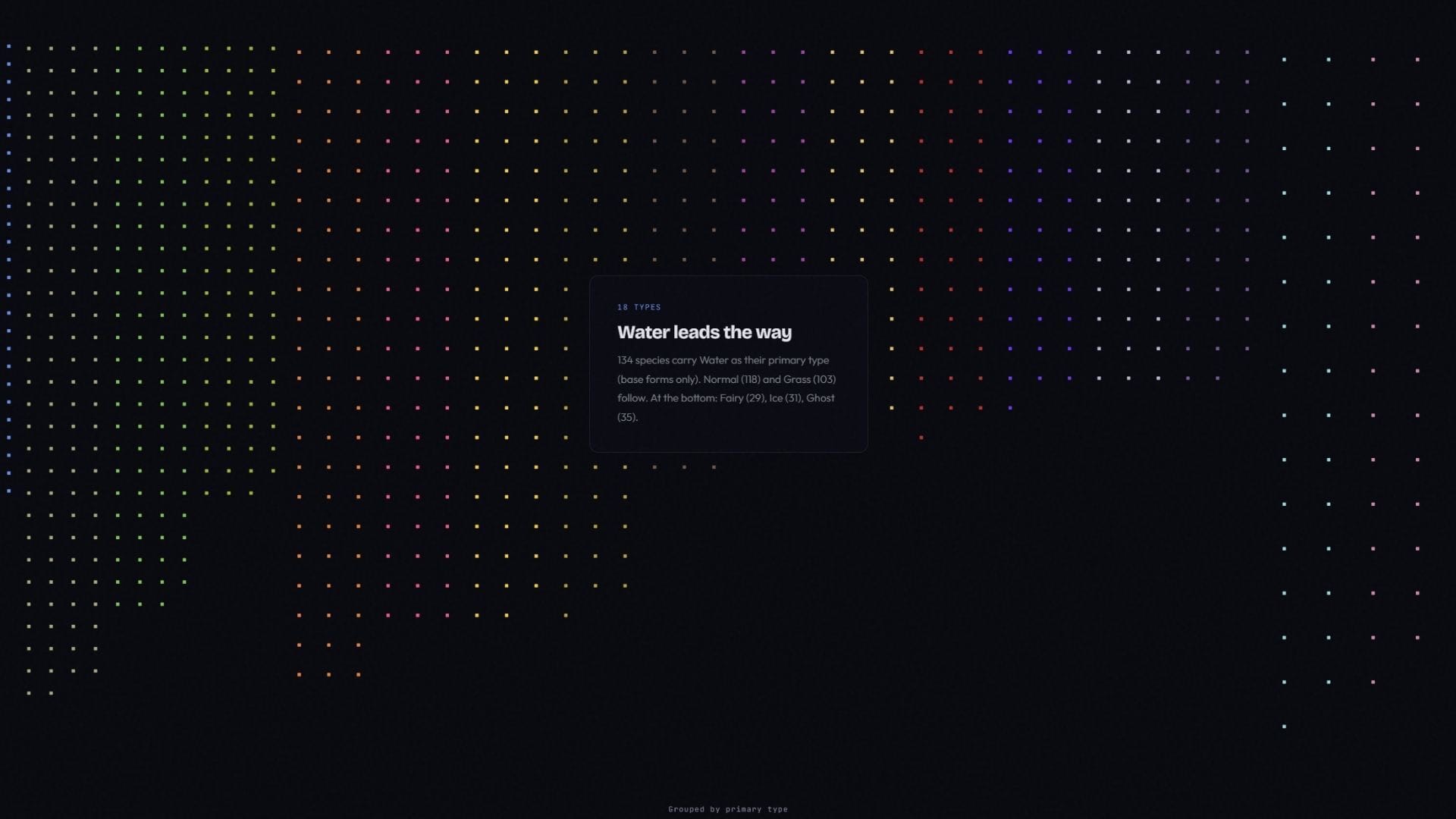
Arguably, the best element of the site is seeing the little squares move around, smoothly adjusting to meet different patterns - but it was also the most difficult part to develop. “Animating that many at once without it turning to mush took the most fiddling,” Akash told me. Fortunately, it’s built to grow, so when the Pokémon Wind and Waves release date rolls around, the new selection of creatures can be added.
But the most interesting thing is the fact that this unique take on the Pokédex serves as measurable evidence that “power creep is real”. Based on the data provided, the first three generations had an average base stat of 405, but every generation since has been higher, climbing to 457 for the Scarlet & Violet games. “Sort the whole dex by generation and the newer Pokémon quietly ride higher up the chart,” Akash continued, “The games have been handing out slightly bigger numbers for 25 years.”
It’s a really interesting piece of evidence that the latest Pokémon have been, on average, stronger than earlier entries. And, this was all told by a huge selection of little blocks just on one screen. I asked Akash what was the proudest part of making the project, and their answer was simple: “Honestly just that it's all of them, in one place, hand-built, and it loads and works.”
You can check out the website here. It’s a lovely project that highlights the creativity of the fandom. I hope that Akash makes one that includes every Pokémon TCG set - that would be fun to view, although, likely massive.


