
“Just plain illegal, unlicensed gambling”: Expert says Pokémon TCG mystery slabs and repacks may breach gambling and consumer laws
Pokémon mystery products promise collectors the chance to pull valuable cards, so we spoke with Dr. Leon Xiao who believes some may breach UK law. We investigate the companies, products, and legal questions behind the booming market.
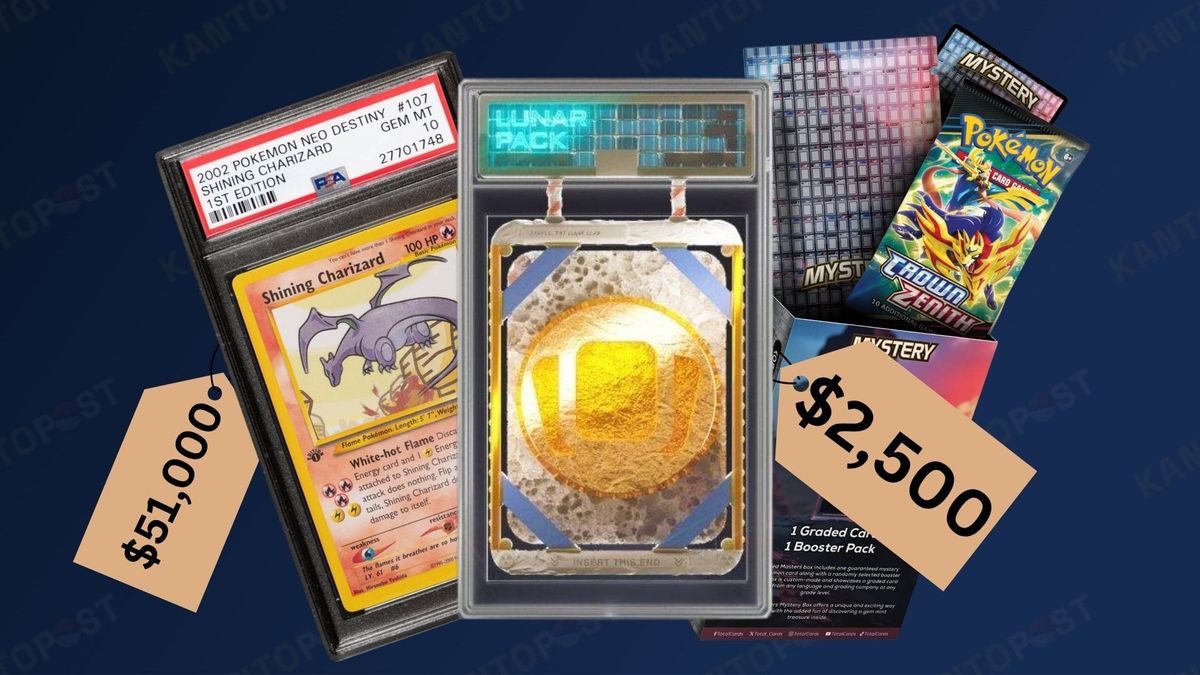
Over the last few years, Pokémon card collecting has evolved beyond simply opening packs and completing sets. Rare cards have increasingly been treated as investments by parts of the collecting community, sealed products have been stored away, and the excitement of finding valuable cards has become part of a growing marketplace built around chance. Products like GameStop’s Power Packs have accelerated that shift, pushing the hobby further from collecting towards the pursuit of value.
Pokémon TCG repacks aren’t a new concept. The idea of sealing random bulk alongside valuable cards has been done for years, and they’re even sold in retail stores. As the TCG’s value has skyrocketed, single packs of product from just a few years ago can cost an arm and a leg, and repacks have extended past single cards to more valuable packs or graded cards, going from simple mystery packs into expensive products marketed around the possibility of finding significant value.
GameStop’s Power Packs, Poke Queen’s repacks, Total Cards’ Graded Masters, and Ripit’s platform all share a similar mechanic: consumers pay money for a randomised outcome, with the possibility of receiving something worth more, less, or roughly equal to their purchase price.
My initial question going into this investigation was simple: “Is this gambling?” Much like my Whatnot investigation, I expected a debate filled with grey areas and conflicting opinions. Instead, the more I examined these products, the bigger question became: when does a product like these become something that requires regulation?
While regular packs from any of the Pokémon sets have the chance of getting increasingly rare cards, it’s not an equivalent. From a production perspective, a Mew ex #232 and a Jacinthe #122 are both simply printed cards from the same rarity. To collectors, however, they exist in completely different worlds. One can sell for hundreds or even thousands of pounds, while the other may be worth only a fraction of that. The secondary market creates the financial gap between cards, turning some pulls into highly valuable prizes.
Repacks have always held that philosophy, but in a uniquely different way. Repackaged bulk cards mixed with high value cards may sound similar, but it’s in the marketing where things are different. Booster packs are plastered with artwork highlighting the Pokémon of each set, while repacks showcase the most sought-after cards. That’s a small difference that can make a huge difference in desirability. Boosters sell that “catch ‘em all” philosophy, but repacks sell the chance of “winning”.
When these are simply placed in supermarket shelves and go for around or under £10/$10, they’re a low-cost novelty purchase that could end in smiles or disappointment. As the price of cards has risen, so too have the potential outcomes, and therefore, the “buy in” cost.
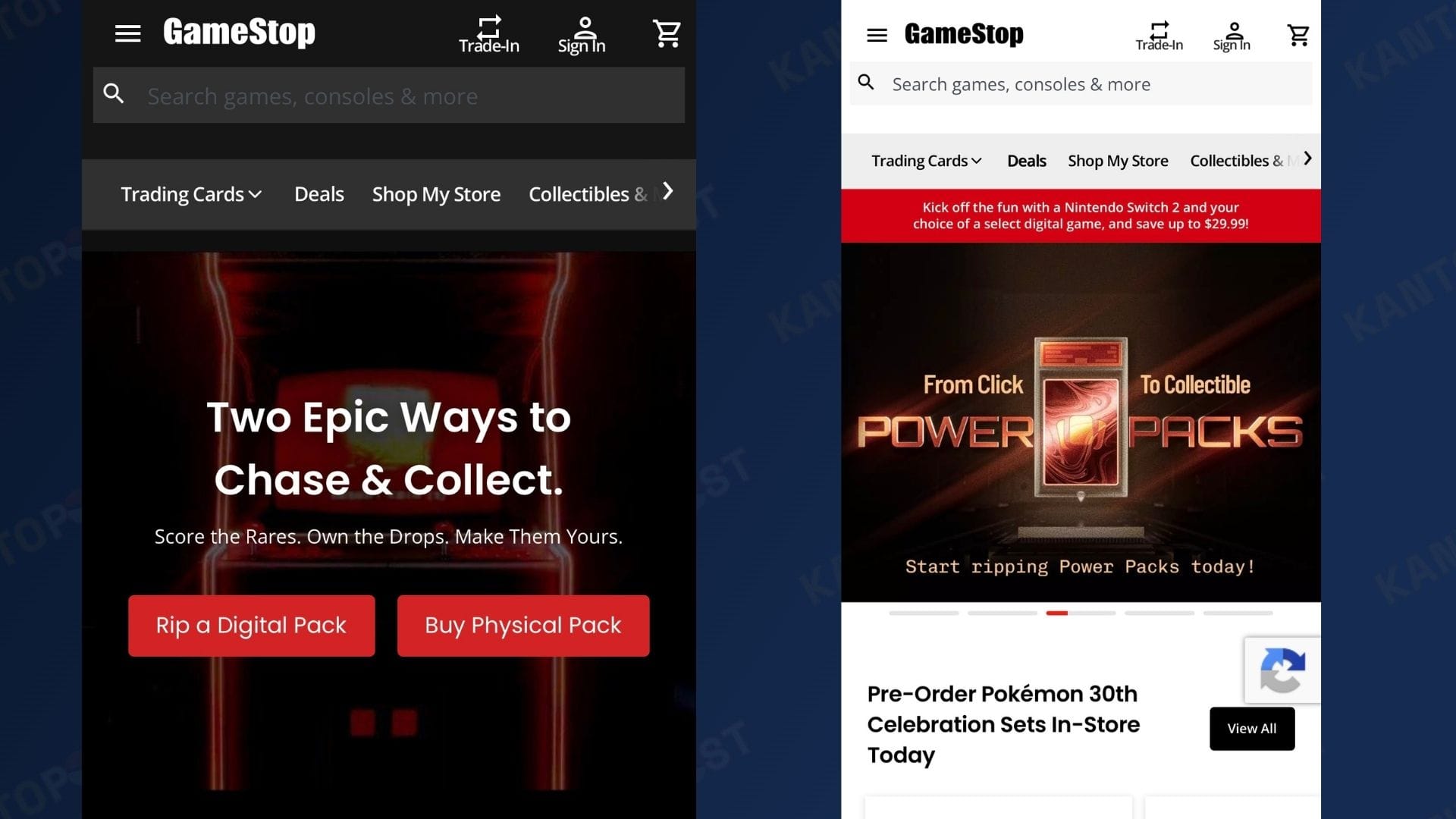
Take Power Packs, for example. It’s not a simple side project - one look at the official website, and the banner for Power Packs remains front and centre. Offering both digital and physical solutions to a problem you never wanted or needed, Power Packs start at a measly $25, but five tiers later, reach the colossal $2500. That’s the equivalent of almost 17 booster boxes or 612 packs of cards. This isn’t a neat extra, but a major part of GameStop’s modern strategy. In the company’s Q1 2026 financial report, collectibles made up 41.8% of GameStop’s revenue, beating both hardware and software.
Every card carries an assigned value, and buyers can choose to sell qualifying pulls back to GameStop for cash or credit. That creates a different relationship between consumer and product: the card is no longer simply something to collect, but something increasingly framed around financial value. The equivalent is paying $5 for a Pokémon pack, and The Pokémon Company asking if you would sell that Mega Charizard X SIR back to them, so they can put it back into the pool of potential wins.
“It’s definitely gambling in the sense of a dopamine rush of not knowing what you’re going to get.”
—u/wildwestinitative
“I wanted to start a collection while also getting cards I like and in good quality,” collector and Reddit user u/wildwestinitative said to me. “I knew the odds weren’t very likely but I accepted the risk for building my collection.” Like many other companies offering the same as Power Packs, whether Total Cards or Poke Queen, The odds often aren’t shared. Instead, consumers are shown potential values or examples of possible pulls.
One response from u/wildwestinitative stood out to me, though. “It’s definitely gambling in the sense of a dopamine rush of not knowing what you’re going to get,” the collector said. This felt like a similar response to what my Whatnot piece uncovered, but I had a decent amount of pushback from experts and companies. So, I spoke to Dr. Leon Xiao once again, expecting a similarly nuanced response. His experience as Assistant Professor at the City University of Hong Kong, as well as research into videogame loot boxes, trading cards, and consumer protection, would work well for an expert opinion.

“The specific products you have identified are just plain illegal, unlicensed gambling,” Dr. Xiao stated. That verdict wasn’t limited to GameStop; Dr. Xiao said the same reasoning would apply to similar products where consumers pay for a randomised outcome and can receive cards with materially different values. I then asked Dr. Xiao specifically whether physical repacks sold in the UK would breach UK gambling law: “Physical mystery slab products sold by UK retailers would breach gambling law.”
Dr. Xiao’s interpretation represents one legal analysis, rather than a formal ruling from a regulator or court. I contacted the Gambling Commission and the Competition and Markets Authority for their assessment of these products. Neither had provided a response by the time of publication.
Dr. Xiao’s argument centres on the fact that consumers pay for a random outcome, with the reward being a Pokémon card that can readily be sold for cash. In his view, “the consumer is playing a game of chance for a prize (defined as "money or money's worth," which these cards would be as they can be easily converted into cash),” which means they could be breaching gambling law.
“The specific products you have identified are just plain illegal, unlicensed gambling.”
— Dr. Leon Xiao, Assistant Professor, City University of Hong Kong
When asked about highlighting particularly valuable cards as potential rewards, Dr. Xiao said “It would be misleading and in breach of consumer law if the pack is advertised as if the particularly valuable card could be won more often than what is factually true.” He then further discussed that probability “disclosures are almost certainly required under US, UK, and EU consumer law. But many original packs do not provide sufficient probability disclosure information for players to figure out their exact probabilities for obtaining a specific card.”
Dr. Xiao shared a research paper awaiting peer review and revisions that found that 80% of analysed trading card products did not provide probability information, and while the remaining 20% did, they were often incomplete, hard to locate, or misleading. However, the paper doesn’t focus on how these breach gambling law, but rather, how they affect consumer law in the UK, US, Hong Kong, and the EU, suggesting that consumers require material information to make an informed decision.
While Dr. Xiao noted that some retailers do provide possibility disclosures, GameStop notably doesn’t. And, when compared to typical booster packs, Dr. Xiao noted that “the risk is higher because a lot more money is being spent and risked: the purchase price is a lot higher, and the range of monetary values that the content could represent is also wider.”
Dr. Xiao also suggested that psychological mechanisms studied in gambling, such as the near-miss effect, may warrant further research in relation to Pokémon mystery products. In gambling research, the near-miss effect refers to situations where an outcome feels close to success despite being a loss, potentially encouraging continued engagement. Dr. Xiao said further research would be needed to understand whether similar effects apply to Pokémon mystery products.
While Power Packs is simply one of the many modern takes on repacks, it’s the biggest, both in valuable prizes and community. Like many communities built around chance-based purchases, discussions around GameStop’s repacks often focus on successful pulls, which can make the potential upside more visible than the unsuccessful purchases.
GameStop’s partnership with PSA makes this a lucrative deal for both the retailer and the Pokémon grading service, which the former happily advertises as a major feature on the official website. GameStop isn’t alone in these repack issues, though, Total Cards’ Graded Masters ranges from £29.95 to £349.95, and while the company suggests you’ll receive a graded card valued on either side of the price you pay, there’s also no indication of your odds of winning a more valuable prize.
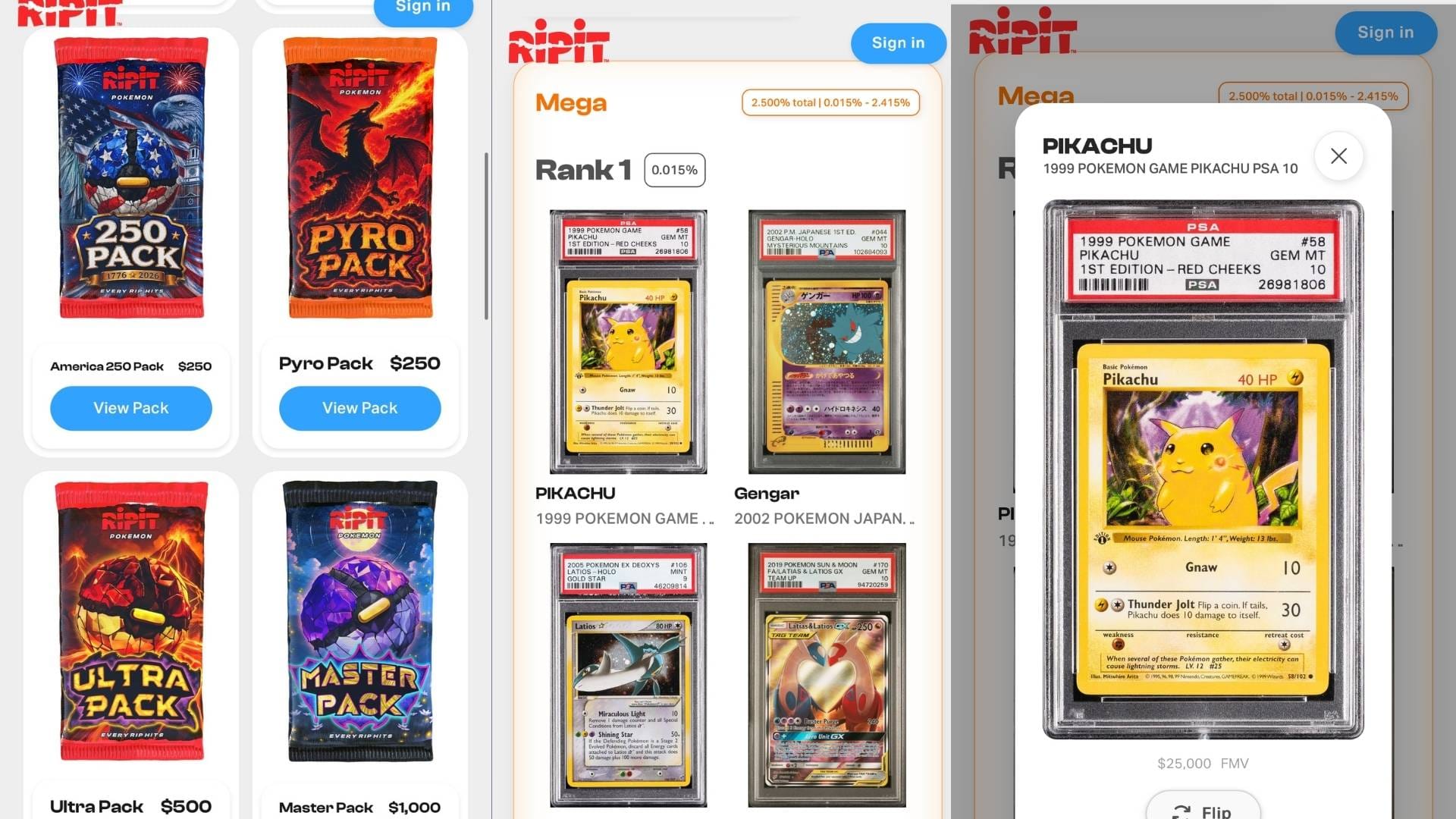
Surprisingly, the new ‘Ripit’ platform does offer odds, although they are unproven at time of publication. A Master Pack, which will set collectors back $1,000, offers a 0.015% chance (roughly 1 in 6,667 packs) of getting a Rank 1 card, like the 1999 Pikachu in a PSA 10, which is valued at $25,000. You’re more likely to win a Rank 3 ‘Heat’ card at 25% chance, many of which are worth half of the master pack’s initial price. Ripit’s disclosure highlights the contrast between platforms. While one company provides probability information, others market high-value outcomes without publishing equivalent odds.
This isn’t exclusive to Pokémon, however. Dr. Xiao also highlighted Magic: The Gathering’s collector boosters as another example of higher-priced products built around rare potential outcomes. The 001/001 serialised One Ring is one of a kind, and was bought by Austin Post, better known as Post Malone, for an estimated $2 million. The difference is that MTG’s One Ring was a manufacturer-created rarity within a traditional booster product, rather than a third-party product specifically built around exchanging money for a random chance at financial value.
As Pokémon cards become more valuable than ever before, Dr. Leon Xiao’s thoughts remain that the emergence of such products follows the trend that “some stakeholders in the industry (including but not limited to the card game manufacturers, grading companies, and resellers) are trying to [legitimise] trading cards as ‘investments’ or ‘financial products.’”
Dr. Xiao also shares that “more research asking people about their motivations would be needed,” but suggests that “I don’t think these very expensive repack products are going to be attractive to all consumers because of the high price tag, but I do not see any age restrictions attached to them, so even children could potentially buy them.”
The issue remains that these products don’t incentivise the adventure of building a Pokémon TCG collection, but rather, the chance of winning a major chase. That randomised element is a major part of any booster pack, but when a huge monetary figure is placed on it, alongside the potential of losing money, the water is muddied.
I’ve reached out to the various retailers mentioned in this article. I’ve also reached out for comment from The Pokémon Company, and will update this article if any provide statements.
The Pokémon TCG has always been built around the excitement of the unknown: pulling a favourite Pokémon, completing a set, or discovering a card you never expected. But as collecting becomes increasingly tied to financial value, the biggest chase may no longer be the card itself - it may be the chance of finding something worth more.