

PattyG had spent more than $15,000 in a week and a half on Whatnot, chasing Pokémon cards and paying for blind auctions and mystery packs. “I don’t like how it changed my relationship with collecting,” the collector told Kanto Post. “It felt more like a casino where I constantly p*ss money away, and less like a real experience of opening packs.”
As livestream platforms like Whatnot and eBay Live, services that allow streamers to sell items in live auctions, change how consumers buy products across a range of categories, Pokémon TCG sellers make up its biggest audience. What started as a question about gambling-like mechanics quickly became a bigger one. If buying Pokémon cards increasingly revolves around livestreams, auctions and entertainment, has Pokémon collecting itself started to change?
Whatnot and eBay Live aren’t simply made up of Pokémon card sellers. The best way to describe them is the energy of a bidding war at the end of an eBay auction, but with the seller actively participating in the experience. A hybrid of Twitch and a selling contest, wrapped up into one. It’s the QVC shopping channel, but with live auctions, social interaction and chance-based mechanics layered on top of sealed products.
Whatnot’s meteoric rise - and its current $11.5 billion valuation - is thanks to the company’s ability to mix social entertainment with commercial intent, turning auctions into interactive experiences. It’s not just Pokémon that played a big part in this global rise - it’s sneakers, collectibles, and women’s fashion.
It felt more like a casino where I constantly p*ss money away, and less like a real experience of opening packs.
— PattyG
Pokémon remains the biggest category on the platform by viewer count. On a random Sunday at 7am, there were 13,000 viewers on TCG content, with 11,000 of them buying packs from Pokémon sets and chatting about the latest developments in the card game. The second highest category was women’s fashion, with 8.9k viewers across various subcategories.
As more sellers join these platforms, standing out has become increasingly important. Over time, streamers have introduced concepts to layer additional chance-based mechanics on top of the randomness already present in Pokémon booster packs. These include blind packs, giveaways, respins, and break spots, where buyers pay for a randomly assigned portion of a pack-opening session rather than knowing exactly what they’ll receive.
“I first started getting into blind packs because I liked the extra thrill of gambling.” PattyG told Kanto Post. “In my experience it absolutely does have a different feel than opening booster packs.” After spending $15,000, which Kanto Post verified privately, PattyG had some regret. “I don't regret it financially because (thankfully) I can afford it, but I don't like how it changed my relationship with collecting.”
PattyG then went on to say that they “ended up spending more than I had originally planned, mostly because they set it up in such a way to make it seem like a casino.” When asked if any collector who hasn’t used the platform should try it, PattyG said they would tell them to “run the opposite direction,” before adding “I would tell them to look at how statistically unlikely it is to pull one big card out of thousands of mystery packs. Just buy the card you want instead.”
What makes services like Whatnot so distinct from random auctions on marketplaces like eBay, or even luxury services like Goldins, is the community aspect. Based on our own experience, streamers will remember returning users, chat about their days, reference current events like the World Cup, and become social with one another.
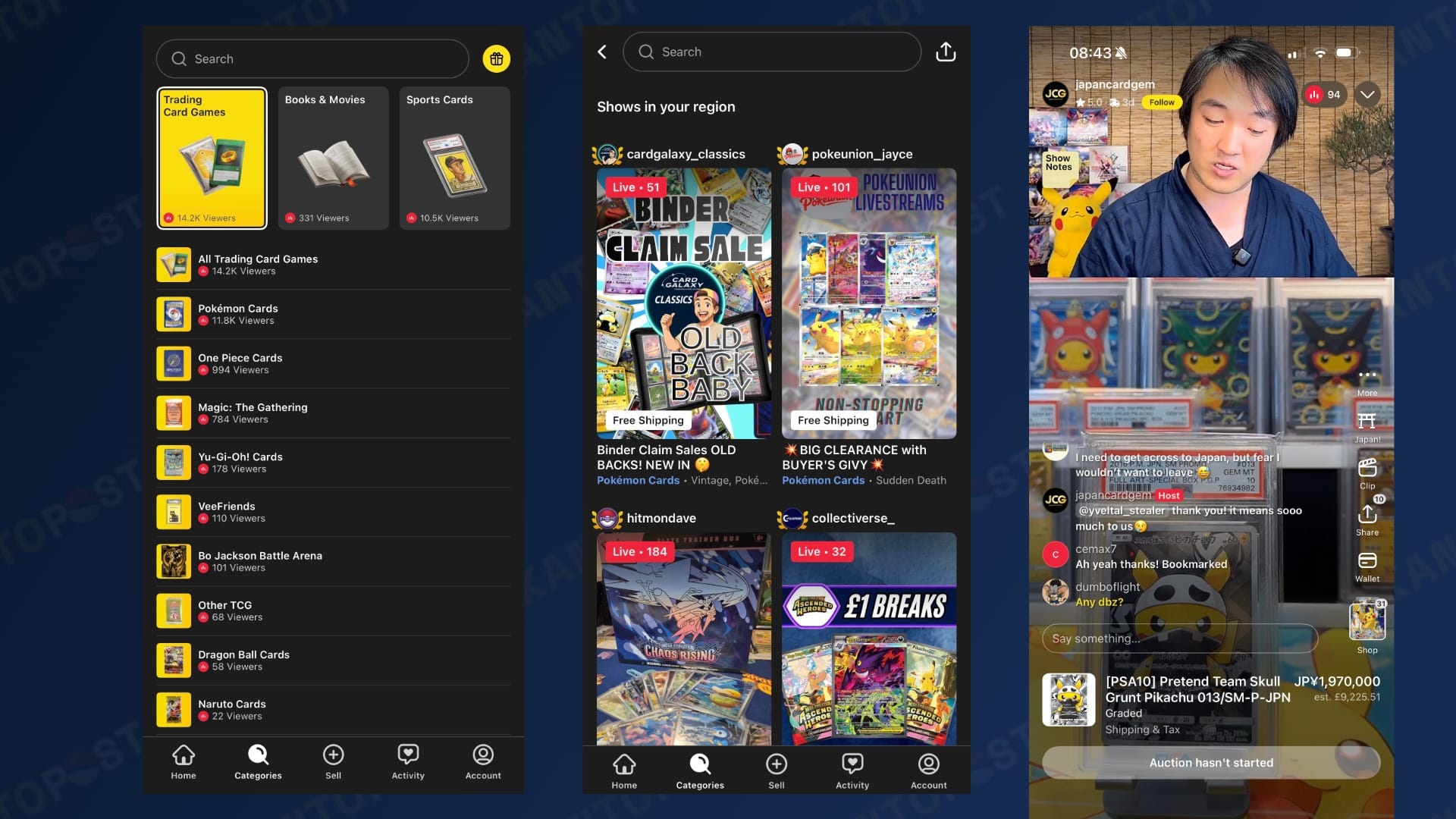
That’s not unusual for livestreaming platforms. Twitch and YouTube streams offer the same experience, but when the service is focusing on selling products, that social aspect can feel distinctly different; it’s no longer about community, but the eventual purchase of products in a commercial setting.
The best salespeople will try to make potential buyers feel comfortable, but typically, they’re one-on-one sessions. During Kanto Post’s reporting, many of the largest Pokémon streams regularly attracted more than 100 viewers, with one exceeding 300 shortly after going live. That is heightened by feeling welcomed into a tight crowd of like-minded people. That’s not necessarily a bad thing; Kanto Post has seen people cheer each other on when they win big or small, and users remember each other - it’s not just the streamer and the individual.
To better understand that dynamic, Kanto Post spoke with Dr. Leon Xiao, Assistant Professor at the City University of Hong Kong, whose research focuses on gambling-like mechanics in video games, trading cards and consumer protection.
When asked about the community aspect, Dr. Xiao said “It would not be unreasonable to suggest that people may be more willing to spend money and trust the streamer they know well.” However, he did bring in the potential positives, adding “In fact, community members and even [the] streamer may remind users who are spending quite a lot of money to reconsider or to “buy singles,” thus serving as a protective factor.”
While Dr. Xiao did say that “opening packs are gambling-like psychologically and structurally”, providing a peer-reviewed study co-authored by himself that linked card packs to problem gambling (although, less impactful than loot boxes), he does note that “We have not done much if any proper academic research yet.” Whatnot and similar services are a relatively new concept, one that hasn’t had the research put into it.

“I’d say, based on my observation, that it’s arguably riskier with livestreams because of various factors,” Dr Xiao goes on to say, “including that the streamer can open packs more quickly in bulk than normal players can, so more money can be lost more quickly.”
Unlike many regulated gambling products, Pokémon doesn’t publish official pull rates. While collectors have developed estimates through thousands of recorded openings, every new pack still carries uncertainty. On livestream platforms, the randomness of opening Pokémon packs doesn’t disappear. Instead, it’s layered with countdowns, public auctions, community interaction and additional chance-based mechanics.
When asked about these additional mechanics, Dr. Xiao says that “These are risk factors, but we need to do more research to be sure. They might make the products more potentially harmful by increasing spending, and certainly are not there to make the products less harmful.”
He also mentions the fact that platforms like Whatnot offer introductory offers or discounts to consumers in order to get them to make their first purchase. This isn’t bad on its own, but it becomes more complicated with what individual streamers can offer. However, these aren’t mechanics that individual streamers have developed, but built-in tools for sellers from Whatnot.
Dr. Xiao makes it clear that more research needs to be conducted in this area. However, he does believe that more can be done to protect consumers, including optional spending reminders, pop-ups reminding users about spending and risks, stronger streamer verification, and deposits for streamers to improve consumer redress.
The only true way to understand how widely used these mechanics are is to get involved in the community. So, over a week and with 20 hours spent, Kanto Post watched 25 streams, using the top three Pokémon streamers at random days and times as reference. While mystery pack openings weren’t as common as we expected (although, there were a couple), the use of marketing tactics was plentiful, even in basic auctions.
Over half of the streams contained giveaways, many of which required the community to meet certain goals like spending a certain amount or buying enough products. Five had “break spots” with messaging like “rip until you hit big”, and buried further in the show’s notes were “bid responsibly” notices.
Multiple streams had five-second or lower auction times, making auctions more intense and pressuring than typical purchases. However, out of those, three streams didn’t use any marketing tactics or loud personalities - one in particular stood out to us, as a Japanese man sold valuable graded cards sent from Japan. There were no quick-paced auctions, just expensive cards to an engaged community.
Across the 25 streams observed by Kanto Post, many of the engagement mechanics described by PattyG and discussed by Dr. Xiao appeared repeatedly. These were by far the most popular shows on the platform at the times we had watched, and many of them were above 100 viewers at any one time - one even had 300 watchers when it started.
Even those that had “buy what you see” auctions used the same techniques as other streamers did, including giveaways with high requirements and AI-generated photos that promote free products and low-prices.
It’s arguably riskier with livestreams because the streamer can open packs more quickly in bulk than normal players can, so more money can be lost more quickly.
— Dr. Leon Xiao
During one stream, one person had spent £30 on three White Flare packs, a 500% increase over the typical retail price of a booster. After being ripped open on stream, the buyer then said “Are they any good? It’s the first time I’ve ripped White Flare.”
After speaking with Dr. Xiao and watching Whatnot streams, Kanto Post reached out to the company with questions relating to the investigation. “Our trust and safety team is the largest department in the company. About 1 in 3 of our 1,000+ employees work in it, and it more than doubled in 2025,” a Whatnot spokesperson said.
Whatnot rejected comparisons between its marketplace and gambling, stating that “Gambling isn't allowed on Whatnot, and we strictly enforce this policy.” The platform also has existing policies on card breaks, surprise products, and professionally sealed surprise products. Streamers who break the rules could receive consequences including “billbacks so sellers don't profit, plus warnings, suspensions, loss of selling privileges, or removal depending on severity and account history.”
The Whatnot spokesperson also added that “any new pack of trading cards is a blind pack[,] whether you buy it on Whatnot or off a store shelf.” The platform has already introduced safety measures that Dr. Xiao had suggested, including watch and spending limits, as well as ID verification for sellers. Kanto Post verified that these controls are available through the platform’s Account Controls but must be enabled by users rather than being active by default.
As for the community aspect, the spokesperson said that the platform is “a place where people come together to connect over shared passions and discover the things they love, from Pokémon and trading cards to fashion, collectibles and beyond.” To help with this, the platform bans “tens of thousands of accounts a week” with its fraud models, enforcing its rules with a mix of human and technology reviews.
That part about the social element of Whatnot is one that Dr. Xiao also brought up. He said “I don’t think this is necessarily always a bad thing because the community does provide opportunities for people to socialise and share their hobbies.” Before adding “In fact, community members and even streamers may remind users who are spending quite a lot of money to reconsider or to “buy singles,” thus serving as a protective factor.”
Whatnot is a place where people come together to connect over shared passions and discover the things they love.
— Whatnot spokesperson
However, even if services like Whatnot need further research to uncover whether the mechanics are gambling, our reporting suggests it has reshaped how some collectors treat the hobby. Every “hit” stream, where buyers only receive valuable cards while bulk is discarded or redistributed, changes the purpose of opening packs. Rather than experiencing an entire booster, collectors increasingly pay for only the chance of hitting something expensive.
Regardless of whether Whatnot’s various mechanics count as gambling or not, the resulting feeling of losing out feels the same. PattyG said “I could’ve purchased a Black Label Umbreon VMAX Alt Art at the time for around that price. Or I could’ve purchased a [tonne] of vintage boxes.”
Most collectors would talk with other players or Pokémon TCG fans prior to buying a new set. They’d look into the card guide, finding out which chases they like before pressing the buy button. That personal research is lost with Whatnot. Much like the buyer who spent a huge amount over retail for White Flare, they didn’t ask before whether what they had was good - they asked after they’d already hit the buy button.
Whether future research points to Whatnot using gambling mechanics or not, we’ve reached a point where the very opening of Pokémon packs becomes entertainment. For collectors who enjoy opening packs themselves, livestream buying changes the experience. The excitement of shuffling through bulk, discovering unexpected cards and opening packs in your own hands is replaced by watching somebody else do it live.
For some collectors, opening packs of Pokémon cards is no longer simply about the cards themselves; it’s about participating in the show.
We reached out to the UK’s Gambling Commission and the National Council on Problem Gambling in the United States with a request for comment prior to publication. We will update this story if they respond.
Editor's Note: Whatnot provided Kanto Post with a detailed written statement addressing community, consumer protection, Trust & Safety, and platform policies. Relevant excerpts have been quoted throughout this article. You can read the full statement from Whatnot here.


