

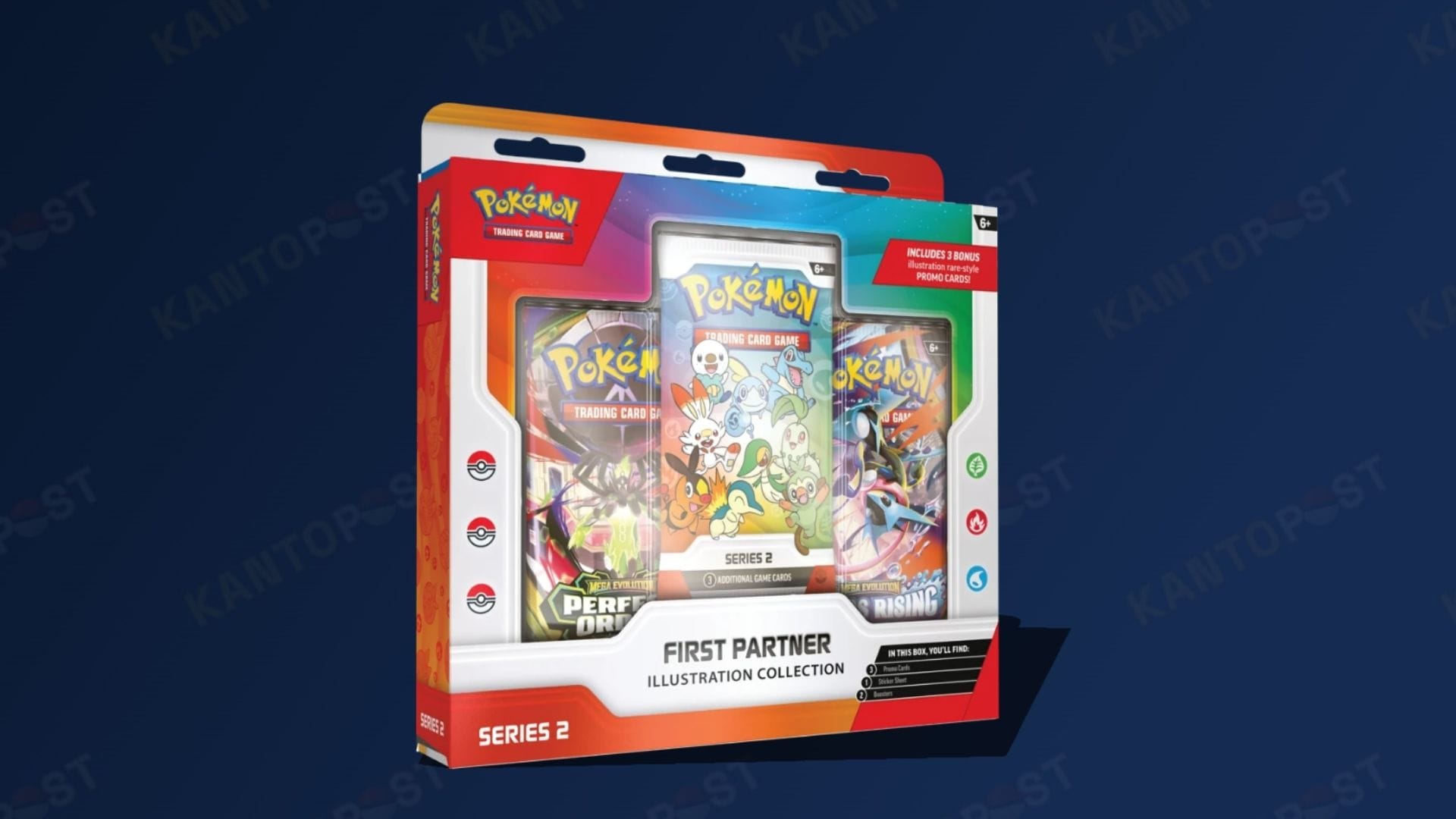
UK retailer Unicorn Cards has defended its decision to sell the Pokémon TCG First Partner Collection Series 2 for £59.90, claiming allocations on some Pokémon products are as low as six to twelve units, making retail pricing commercially unviable.
As Pokémon TCG demand continues to heavily outweigh supply, frustration in the community is constantly bubbling up. Retail price stocks fly off shelves at a breakneck pace, so when a retailer sells new products over retail, the community can get rightfully outraged. However, according to one retailer, it’s a problem created by scalpers, investors, and the high cost of running a business.
While it’s far from the only example, retailer Unicorn Cards was caught in the firing line on the weekend, with Pokémon TCG collectors upset that the company was selling the First Partner Series 2 box for £59.90. That’s an almost 300% increase over the retail price of £14.99, and matching the market price from secondary sellers.
The backlash was almost immediate. After being shared on the r/PokémonTCG_UK subreddit, there’s been plenty of 1-Star reviews shared on the TrustPilot platform for the retailer. At time of writing, the listing for the First Partner Series 2 box has been removed from Unicorn Cards’ site.
“Our pricing approach has always been market-based. In 99.99% of cases, that means products are priced at or below RRP, and often well below RRP,” Slava Gavrilov from Unicorn Cards said in a statement to Kanto Post, “Demand is no longer driven only by people who want to open, collect or play with the cards.”
Gavrilov blames investors, social media hype, grading culture, and the expectation that sealed products or chase cards may increase in value as other reasons for the existing demand. However, one major issue the retailer faced is a lack of allocation, not only on recent Pokémon sets, but the First Partner collection itself.
“For recent Pokémon products, allocations are as low as 6–12 units,” Gavrilov said, arguing that at those levels “no pricing model realistically covers the cost of running a business.” He added that Unicorn Cards’ operating costs run into the tens of thousands of pounds each month and that receiving only twelve units of the First Partner Collection Series 2 made market pricing seem reasonable at the time.
“That was one product out of roughly 30,000 that we stock, but clearly it was one too many for parts of the Pokémon community,” Gavrilov adds. Although the retaliation from the community was quick, they do say that with foresight, “we would almost certainly have approached it differently.”
Unicorn Cards is far from the only retailer listing Pokémon products above RRP. GameStop is a big example of a larger seller having above retail price listings, and just one brief search on Google showed multiple selling the First Partner Series 2 box for above RRP, including Meeples Corner and Shop4Ducks, as well as multiple eBay listings.
“Based on the feedback we received, we will make sure to list upcoming comparable Pokémon products at RRP, even though that does not create a commercially meaningful result for us” Gavrilov shares in regret. “Our aim is still to support the hobby and the community as much as we can. But the current Pokémon supply situation is extremely challenging.” You can read Unicorn Cards’ full statement below, at the end of this article.
The response highlights the difficult position some retailers say they face as Pokémon demand continues to outpace supply. Unicorn Cards did not respond when asked whether alternatives such as lottery systems, invite-only sales, or customer purchase limits were considered before pricing the product at market value.
For collectors, however, the frustration remains unchanged. When newly released products are difficult to find at retail price, seeing them listed above RRP by retailers can feel no different from encountering inflated secondary market prices. With Pokémon’s 30th Celebration approaching, supply and pricing are likely to remain major talking points within the community.
If you’d like to get some retail-priced stock or keep up-to-date on all things Pokémon, make sure to subscribe to our newsletter above.
You can find the unedited statement in full below.
Hi Callum,
Thank you for getting in touch and for giving us the opportunity to comment.
We completely understand why Pokémon collectors are frustrated. Unfortunately, in this case, we seem to have unwillingly become an easy target for that frustration. Pokémon has become incredibly difficult to buy at fair price, and in many cases difficult to buy at all. Demand has increased dramatically, not only from collectors and players, but also from people treating Pokémon products as an investment.
It may be hard to believe now for people who joined Pokémon collecting more recently, but for most of the last 20 years this was not the case. We have been trading Pokémon products for around 18 years, and for the vast majority of that time Pokémon sealed products were regularly selling below RRP, often significantly below it. Elite Trainer Boxes, for example, were commonly sold by us in the £32.90–£39.90 range (they are still listed on our website). Those were normal market prices at the time, and nobody would have described selling below RRP (market ptice at the time) as unfair.
Our pricing approach has always been market-based. In 99.99% of cases, that means products are priced at or below RRP, and often well below RRP. That same principle still applies across most other trading card games where supply is adequate and demand is driven mainly by players and collectors. Even hugely popular games such as Magic: The Gathering, Yu-Gi-Oh!, Digimon and Riftbound are generally available at competitive prices, often below RRP. In those markets, everyone is broadly happy: retailers have products to sell, and players and collectors can buy them at sensible prices.
Unfortunately, the dynamics around Pokémon have changed dramatically. Demand is no longer driven only by people who want to open, collect or play with the cards. It is also heavily influenced by investment demand, social media hype, grading culture and the expectation that sealed products or chase cards may increase in value very quickly. That creates a very different market from the one Pokémon had for most of its history.
As a retailer, we are equally affected by this scarcity, if not more so. A few years ago, we were receiving hundreds of units of Pokémon collector boxes, blisters and promo products, and we were able to sell them well below RRP. That is simply not the market we are in now. For recent Pokémon products, allocations are as low as 6–12 units. At that level, no pricing model realistically covers the cost of running a business: rent, salaries, VAT, utilities, postage, payment fees and all the other costs that run into tens of thousands of pounds per month.
So, coming back to your question, the First Partner Illustration Collection Series 2 was indeed listed at current market price, which in this case happened to be well above RRP. That was one product out of roughly 30,000 that we stock, but clearly it was one too many for parts of the Pokémon community.
Our total allocation was only twelve units, so it was treated in the same way as many other small-quantity products: the team checked the prevailing online market price and listed it accordingly. At the time, it did not seem like a decision that would cause such a strong reaction. Had we realised how strongly Pokémon collectors would feel about it, we would almost certainly have approached it differently.
Ultimately, the underlying issue is that Pokémon demand massively exceeds supply, and there are nowhere near enough products available for everyone who wants them. Based on the feedback we received, we will make sure to list upcoming comparable Pokémon products at RRP, even though that does not create a commercially meaningful result for us, nor does it solve the underlying problem for collectors and players. With such small allocations, those products will simply be bought by the first few lucky customers, or potentially by people using bots or multiple accounts. Everyone else will, unfortunately, still be disappointed.
More broadly, Pokémon has become a very difficult category for everyone involved. What used to be an enjoyable and accessible hobby has, in many cases, become a source of upset and frustration for collectors, players and retailers alike.
Our aim is still to support the hobby and the community as much as we can. But the current Pokémon supply situation is extremely challenging, and we think it is important that the wider conversation reflects the commercial reality for retailers as well as the understandable disappointment felt by collectors.
Kind regards,
Slava Gavrilov
Unicorn Cards


